
While humans rely on technology to push the boundaries of speed, strength, and survival, the natural world has spent hundreds of millions of years engineering biological capabilities that sound like pure science fiction. From creature-wide immortality and atomic-scale adhesion to organic chemical cannons and bone-shattering strikes, here is the definitive deep dive into 15 animals equipped with extraordinary, real-world superpowers.
1. The Platypus
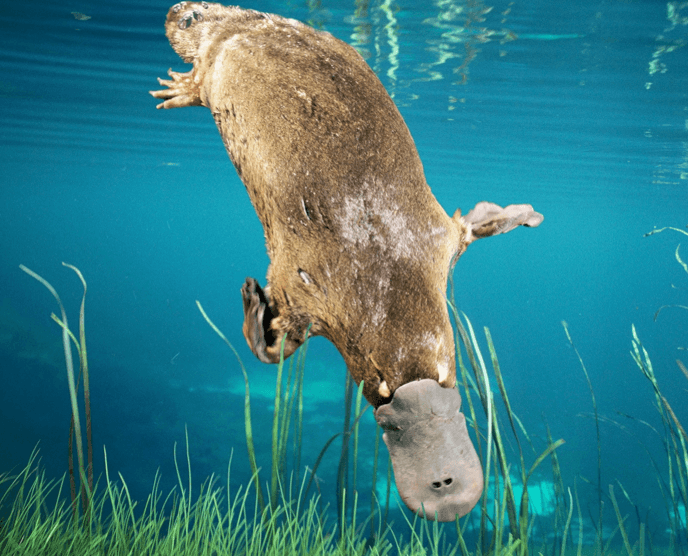
The platypus is a biological marvel that possesses an extraordinary array of sensory adaptations, making it an apex freshwater hunter. When this mammal dives into murky rivers to search for prey, it completely closes its eyes, ears, and nostrils to prevent water from rushing in. Navigating in total sensory darkness, it relies entirely on its superpower: a highly advanced leathery bill. This bill is embedded with roughly 40,000 specialised electroreceptors alongside tens of thousands of tactile mechanoreceptors. These receptors are so incredibly sensitive that they can detect minute electric fields—as weak as 1.5 millivolts—generated by the tiny muscle twitches and heartbeats of buried crustaceans and insect larvae hidden deep in the mud. By processing the delay between the electrical signal of a muscle twitch and the physical ripple of water pressure hitting its bill, the platypus’s brain creates a high-definition, real-time 3D map of its surroundings, allowing it to strike with deadly, unseeing accuracy.

2. The Elephant
Aside from possessing a trunk engineered with over 150,000 distinct muscle units, elephant possesses a localised form of telepathic communication. They converse across the vast African savanna using “infrasound”—deep, rumbling, low-frequency vocalizations that fall far below the threshold of human hearing (between 1 and 20 Hertz). Because low-frequency waves do not degrade quickly in the air and can penetrate solid objects, these sound waves travel directly through the earth. Other elephants can “hear” these messages from up to 20 miles away. They accomplish this by picking up the seismic vibrations through nerve endings, called Pacinian corpuscles, located in the soft, fatty pads of their feet and the sensitive tips of their trunks. When an elephant suddenly stops, leans forward, and presses its weight onto its front feet, it is literally listening to the ground to hear warnings of predators, weather changes, or mating calls from herds miles away.

3. The Archerfish
The archerfish (genus Toxotes) has evolved to hunt land-dwelling insects perched on leaves and twigs up to two meters above the water’s surface by transforming its own mouth into a high-powered, biological water cannon. By pressing its tongue against a specialized grooved ridge on the roof of its mouth, the fish forms a narrow gun barrel. It then snaps its gill covers shut to force a high-velocity stream of water toward its target. Crucially, the fish actively alters the speed of the water jet during ejection—firing the tail end of the stream faster than the front. This causes the liquid to gather into a single, heavy impact droplet right before hitting the prey, delivering maximum kinetic force to knock the insect into the water. Even more impressively, the archerfish instinctively calculates Snell’s Law of Refraction to account for the severe bending of light at the water’s surface, adjusting its firing angle perfectly to ensure pinpoint accuracy on a target that isn’t actually where it appears to be.

4. The Axolot
The axolotl (Ambystoma mexicanum), a critically endangered neotenic salamander native to the ancient lake complexes of Mexico City, holds unparalleled regenerative capabilities. While most vertebrates, including humans, form thick, fibrous scar tissue to quickly close deep wounds and prevent infection, the axolotl opts to completely rebuild complex biological structures from scratch. If an axolotl loses a limb, portions of its spinal cord, its jaw, or even large chunks of its brain and heart, its immune system immediately sends macrophages to the wound site to suppress severe inflammation. Following this, the surrounding cells undergo a process called dedifferentiation—essentially reverting back into embryonic-like stem cells. These cells aggregate to form a specialized mass called a blastema, which seamlessly regrows the lost anatomy perfectly. It reconnects every blood vessel, nerve ending, muscle fiber, and bone segment without leaving a single microscopic trace of scar tissue.

5. The Spotted Hyena
The spotted hyena (Crocuta crocuta) possesses a gastrointestinal system that borders on the indestructible, allowing it to thrive in the harsh, competitive environments of the African savanna. Their stomachs contain highly concentrated hydrochloric acid, boasting an incredibly low pH level of around 1.2 (similar to battery acid). This extraordinarily corrosive environment allows them to completely digest materials that would kill or cause severe blockages in other scavengers, including dense bones, hooves, tough ligaments, and keratin-rich horns. Within 24 hours, a hyena can reduce a massive carcass to nothing but a chalky white paste. Furthermore, their immune system is supercharged with specialized, hyper-aggressive antibodies, allowing them to safely consume rotting, putrid meat infected with deadly pathogens like anthrax, rabies, and botulism without suffering any physiological ill effects.

6. The Gecko
Geckos are renowned for their seemingly magical ability to run straight up polished glass walls and sprint upside down across ceilings. This feat is not accomplished through sticky mucus, liquid glues, micro-suction cups, or mechanical claws, but through dry molecular adhesion governed directly by quantum mechanics. The bottom of a gecko’s footpad is covered in millions of microscopic, hair-like keratin structures called setae. Each seta branches off into hundreds of even tinier, nanoscale split ends called spatulae. When a gecko presses its foot against a surface, the physical distance between these spatulae and the surface atoms drops below a single nanometer. At this sub-microscopic scale, weak electrostatic interactions known as Van der Waals forces emerge between the molecules. While a single interaction is incredibly weak, the combined force of millions of these atomic interactions working simultaneously generates an immense adhesive grip, allowing a gecko to support many times its own body weight on a completely frictionless surface.

7. The Bald Eagle
An eagle’s vision is a masterpiece of biological engineering, optimized for extreme, high-altitude precision and tracking. While humans possess a single fovea (the part of the retina responsible for sharp, central vision), eagles have two distinct foveae per eye. This anatomical advantage acts like a built-in zoom lens, giving them the ability to simultaneously process peripheral movement and magnify the dead center of their field of view. Their retinas are densely packed with up to one million light-sensitive cone cells per square millimeter—roughly five times more than a human eye. Additionally, eagles can see deep into the ultraviolet (UV) spectrum, allowing them to track the glowing, UV-reflective urine trails of small rodents hidden in deep grass. This telescopic, multi-spectral visual acuity allows a soaring bald eagle to spot a camouflaged rabbit from over two miles away while cruising at an altitude of 10,000 feet.

8. The Mountain Goat
Mountain goats (Oreamnos americanus) are capable of casually scaling near-vertical, 60-degree cliff faces, icy glaciers, and jagged precipices that would leave even the most equipped human rock climbers entirely baffled. Their superpower lies in the hyper-specialized anatomy of their cloven hooves. Each hoof is split into two distinct toes that can move entirely independently of one another, allowing the goat to spread them wide to grip jagged rocks and narrow ledges like a pair of biological pliers. The outer edge of the hoof is made of hard, sharp keratin that digs effortlessly into ice, snow, and packed dirt. Meanwhile, the inner pad is a soft, spongy, rubber-like convex membrane that acts like a climbing shoe, molding itself perfectly to the microscopic texture of the rock to generate immense, slip-proof friction. Coupled with massive, heavily muscled shoulders designed for pulling their weight upward, they live in vertical environments where no predator dares to follow.

9. The Pit Viper
The pit viper is a master of the ambush, capable of hunting in absolute, pitch-black darkness by utilizing a specialized sensory system that detects thermal radiation. Located exactly between the snake’s eye and nostril on both sides of its head is a pair of deep cavities known as “pit organs.” These pits are lined with a highly sensitive membrane packed with TRPA1 protein ion channels. Unlike our eyes, which process visible light, these channels respond directly to radiant heat. The snake’s nervous system routes this thermal data directly into the optic tectum of its brain, overlaying the heat signatures seamlessly onto its visual field. This biological infrared camera is so exquisitely sensitive that it can detect temperature fluctuations as minor as 0.001°C. This allows the viper to “see” a glowing, high-contrast thermal image of a warm-blooded mouse scurrying through the pitch-black jungle underbrush.

10. The Sockeye Salmon
The sockeye salmon performs one of the most grueling and precise migrations in the animal kingdom, spending years traveling thousands of miles across the vast, featureless expanse of the open Pacific Ocean, yet always managing to return to the exact inland freshwater stream where it was born to spawn and die. This miraculous navigation relies on a dual-sensory superpower. During their oceanic phase, the salmon utilizes magnetoreception—detecting the Earth’s magnetic field through microscopic magnetite crystals embedded in their skulls and tissues—which acts as an internalized biological GPS to guide them toward the correct coastline. Once they reach the mouth of the river system, they switch to a heavily ingrained olfactory memory. They literally “smell” the unique chemical signature and specific amino acid profile of their home stream’s water, following this microscopic scent trail upstream against raging currents and waterfalls until they reach their birthplace.

11. The Wood Frog
While almost all amphibians and reptiles perish if exposed to freezing conditions, the North American wood frog (Rana sylvatica) copes with harsh northern winters by allowing up to 65% of its entire body to freeze completely solid. When temperatures plummet, the frog enters a state of suspended animation: its heart stops beating entirely, its lungs cease breathing, its blood stops flowing, and its brain activity flatlines. As ice begins to form on its skin, the frog’s liver goes into overdrive, flooding its circulatory system with massive quantities of glucose and urea. These compounds act as a potent biological antifreeze (cryoprotectants), drastically lowering the freezing point inside the frog’s cells and preventing jagged, lethal ice crystals from forming and rupturing delicate cell membranes. The frog spends months as a solid block of ice, and when the spring thaw arrives, it warms from the inside out, its heart spontaneously restarts, and it hops away completely unharmed.

12. The Electric Eel
Despite its common name, the electric eel (Electrophorus voltai) is actually a species of giant knifefish native to the Amazon basin, capable of generating electrical discharges that surpass any other living creature. Over 80% of its elongated body is composed of specialized, muscle-derived tissue arranged into three distinct electric organs: the Main organ, Hunter’s organ, and Sachs’ organ. These organs house thousands of stacked, disc-like cells called electrocytes. At rest, each cell maintains a negative internal charge. When the eel’s central nervous system signals a strike, these electrocytes open their ion channels simultaneously, allowing sodium ions to rush in. This creates an in-series electrical potential—exactly like hundreds of batteries linked together. This allows the eel to generate targeted, stunning voltage bursts of up to 860 volts and currents up to 1 ampere, which is more than enough to instantly paralyze massive prey or deliver a catastrophic, muscle-spasming shock to a predator like a caiman or jaguar.

13. The Mantis Shrimp
The peacock mantis shrimp (Odontodactylus scyllarus) possesses the most lethal and biomechanically advanced strike mechanism in the ocean. Equipped with specialized, spring-loaded raptorial appendages called dactyl clubs, this crustacean can accelerate its heavy weapons faster than a .22 caliber bullet—reaching speeds of 51 mph (23 m/s) with an acceleration exceeding 10,000g. The stroke is so violently rapid that it literally tears the water apart, vaporizing the liquid and forming a localized, low-pressure vacuum known as a cavitation bubble. When this bubble immediately collapses upon itself, it unleashes a secondary acoustic shockwave, generating localized temperatures that briefly approach the surface of the sun (thousands of degrees Celsius) and emitting tiny bursts of light (sonoluminescence). The shockwave alone is powerful enough to instantly stun prey, shatter thick clam shells, and easily break heavy aquarium glass.

14. The Mimic Octopus
While many cephalopods use standard chromatophores to blend into the background sand or coral, the mimic octopus (Thaumoctopus mimicus) takes deception to an active, highly theatrical, and cognitive level. It possesses the unparalleled physical ability to deliberately impersonate highly venomous sea creatures to terrify and deter specific predators. By aggressively altering the color of its skin and contorting its boneless, highly flexible arms, it can instantly mimic the flat, undulating shape and swimming motion of a toxic sole fish. If harassed by damselfish, it will bury six of its arms in the sand and raise two banded arms in opposite directions to perfectly mimic the highly venomous, aggressive banded sea snake. It has also been documented shifting its tentacles to replicate the sprawling, venomous spines of a lionfish, proving it can dynamically choose its disguise based on the specific threat it faces.

15. The Peregrine Falcon
The peregrine falcon (Falco peregrinus) is the undisputed fastest animal on the planet, capable of reaching breathtaking speeds of over 240 mph (386 km/h) during its specialized hunting dive, known as the stoop. To survive and function at this extreme terminal velocity, the falcon has evolved several spectacular aerodynamic superpowers. To prevent the massive, high-pressure rush of air from bursting its lungs during the dive, the falcon features small, cone-shaped bony structures inside its nostrils called tubercles, which safely deflect the shockwave of air and allow the bird to breathe easily. Furthermore, a specialized, transparent third eyelid—the nictitating membrane—acts like biological safety goggles. It clears debris and rapidly spreads tears to keep the eyes perfectly moist, allowing the bird to maintain a flawless, high-definition target lock on a pigeon while hurtling downward at 240 mph.

16. The Nile Crocodile
The Nile crocodile (Crocodylus niloticus) boasts the most powerful bite force ever accurately measured in the modern animal kingdom, clamping down on its prey with a staggering 5,000 pounds per square inch (PSI) of pressure. To achieve this bone-crushing, inescapable power, the crocodile’s jaw anatomy has been highly modified by evolution; an extraordinarily massive portion of its skull is dedicated entirely to housing oversized, rock-hard adductor muscles. Additionally, they possess a unique secondary jaw joint that effectively spreads the immense mechanical stress across the solid bone of the skull, preventing their own jaws from shattering when they violently crush the femur of a wildebeest or zebra. Interestingly, while the muscles that snap the jaw shut are a marvel of biomechanical power, the muscles used to open the jaw are incredibly weak, meaning a human can easily hold a crocodile’s mouth shut with their bare hands or a simple strip of duct tape.

17. The Sperm Whale
The sperm whale (Physeter macrocephalus) is the loudest animal on planet Earth, possessing a superpower built for hunting in the lightless, crushing depths of the ocean. Deep within its massive, block-shaped head lies the spermaceti organ, a complex network of oil and air sacs that amplifies and directs echolocation clicks. These acoustic clicks can reach an astonishing 236 decibels—significantly louder than a jet engine at takeoff. The sound waves are so intensely powerful and focused that they act as a biological sonic weapon, physically paralyzing giant squid in the pitch-black depths so the whale can consume them without a fight. Furthermore, to reach these abyssal hunting grounds, the whale’s ribcage is biologically hinged and designed to collapse entirely without breaking. This prevents the bones from snapping under the lethal water pressure of dives exceeding 10,000 feet, while specialized myoglobin-rich blood stores massive amounts of oxygen for the journey.

18. The Immortal Jellyfish
Turritopsis dohrnii, famously known as the immortal jellyfish, has completely bypassed the biological rules of aging and death. When subjected to severe physical damage, starvation, extreme temperature shifts, or environmental stress, this tiny, bell-shaped hydrozoan avoids perishing by executing a miraculous biological process known as transdifferentiation. Instead of deteriorating, the adult medusa jellyfish absorbs its own tentacles, rapidly reduces its body mass, and settles onto the ocean floor, completely reverting back into a morphologically immature mass of tissue. During this phase, mature, specialized cells (like muscle or nerve cells) completely un-differentiate and transform into entirely different cell types. The mass eventually reconstitutes itself into a juvenile polyp colony, which eventually buds into hundreds of genetically identical, perfectly young jellyfish, allowing the organism to repeat its life cycle endlessly.

19. The Hairy Frog
Native to the dense forests of Central Africa, the hairy frog (Trichobatrachus robustus)—often referred to as the “horror frog” or “Wolverine frog”—utilizes a defensive mechanism that sounds like it was ripped straight from a comic book. Unlike cats, bears, or birds, whose claws are made of keratin and sit within permanent, protective anatomical sheaths, the horror frog’s defensive weapons are made of pure, sharpened bone. Hidden inside the frog’s hind foot pads sit sharp, curved bony nodules anchored tightly to connective tissue. When violently threatened by a predator, the frog consciously contracts powerful muscles in its feet. This intense physical contraction violently snaps the bony nodule completely off its anchor and forces the sharpened bone directly through the skin of its own toe pads. Once the threat passes and the adrenaline fades, the bone slips back beneath the skin, and the frog’s rapid amphibian healing factors seal the wound seamlessly.

20. The Tardigrade
Measuring less than a millimeter in length, tardigrades (affectionately known as “water bears”) are microscopic, eight-legged invertebrates capable of surviving apocalyptic conditions that would instantly annihilate any other known form of life. When faced with lethal environmental extremes, they enter a state of suspended animation called cryptobiosis (specifically anhydrobiosis), expelling 99% of their water and turning into a shriveled, dehydrated ball called a tun. In this state, they synthesize tardigrade-specific intrinsically disordered proteins (TDPs) that literally turn their internal cellular cytoplasm into a glass-like solid, preserving their structures. They can endure freezing temperatures near absolute zero (-272°C) and extreme heat up to 150°C. They can easily withstand crushing pressures 6,000 times greater than the Earth’s atmosphere, and thanks to a unique DNA-shielding protein called Dsup (Damage Suppressor), they can survive massive doses of ionizing radiation and the absolute vacuum of open space.